Wednesday, June 27, 2018

Vicarity Project: Switzerland


Switzerland


Novel:

Heidi by Johanna Spyri (public domain; available on Google Books and free on Kindle)

Summary: An orphaned Swiss girl named Heidi goes to live with her gruff, but kind-hearted grandfather in a small cabin in the Swiss Alps. After a few years of living on the mountain and charming everyone she meets, she is taken to Frankfurt where she becomes a companion for a sick girl named Clara, who is confined to a wheelchair. Heidi charms the household staff (except for the formidable and aptly-named Frau Rottenmeier),  and brings liveliness and adventure into the house with her, but she becomes quite ill herself due to homesickness (which is apparently a real phenomenon. known as “Swiss sickness” because it was so common in Swiss soldiers serving in foreign countries), so she is sent home. Clara comes to visit her on the mountain the next summer and, after a month in the “life-giving mountain air,” gains the ability to walk again.

I had a picture book of this story I was a little girl, but I’d never read the unabridged version. The cover of that book had a cute little tow-headed girl on the cover. It looked something like this:

LIES!

As I have now discovered, Heidi has black hair and dark eyes. All these book covers with little Shirley Temple look-alikes are completely inaccurate. 
Here are two that actually look like what the book describes: 
Heidi running around in her underwear with goats
Heidi collecting flowers in her apron with goats
I once read a funny review of C. S. Lewis’ The Lion, The Witch, and the Wardrobe  in which the reviewer described the book as “a giant advertisement for Turkish Delight.” If that book is an ad for Turkish Delight, then Heidi is an advertisement for goat’s milk and Swiss mountains. The Swiss characters drink goat milk constantly - sometimes two pails full per day. So. Much. Goat Milk. There are A LOT of descriptions of the mountains, the mountain air, the mountain flowers, the breezes through the fir trees, etc., etc. They are lovely and idyllic, and mountain air is the cure for pretty much every ailment – physical, emotional, and spiritual – suffered by the characters in the book.
Despite this rather idealistic view of the curative properties of alpine living, I was really impressed with how the book handled some pretty serious subject matter. Even the “villain,” Frau Rottenmeier, is given some sympathetic character development so that the reader understands that her harsh behavior stems from her own fears and narrow-mindedness, not from any kind of real malice. The gossipy village community, who have long rejected Heidi’s grandfather based on their own ignorance and misunderstanding of him, readily welcome him back into the community once they see how he loves and cares for Heidi – again, they are not bad people; they simply did not understand the whole situation.
There is one particularly touching scene in which Clara’s doctor visits Heidi on the mountain and admits that, even when surrounded by such natural beauty, he cannot overcome his grief at his daughter’s death: “Can you understand, Heidi, that a man may sit here with such a shadow over his eyes that he cannot feel and enjoy the beauty around him, while the heart grows doubly sad knowing how beautiful it could be?” While it may seem inappropriate for an adult man to seek spiritual comfort from an eight-year-old child (and I think that it is!), Heidi responds by quoting a hymn, and the doctor finds some spiritual comfort in the words. In this scene, the mountain is not a cure-all, but it is a place of beauty and solace, where one may find oneself closer to God by being close to nature.
All in all, Heidi is a lovely book with strong spiritual themes and multiple stories of redemption and healing. It was written in 1880, which no doubt explains some of its more saccharine elements and its insistence on the health benefits of mountain air.  
That being said, I think Switzerland is the first place I remember being absolutely stunned by a sunset. I was 6 or 7 years old when I went for the first time, and even at that young age, I knew it was special. It really is one of the most beautiful countries in the world. Johanna Spyri was not wrong.
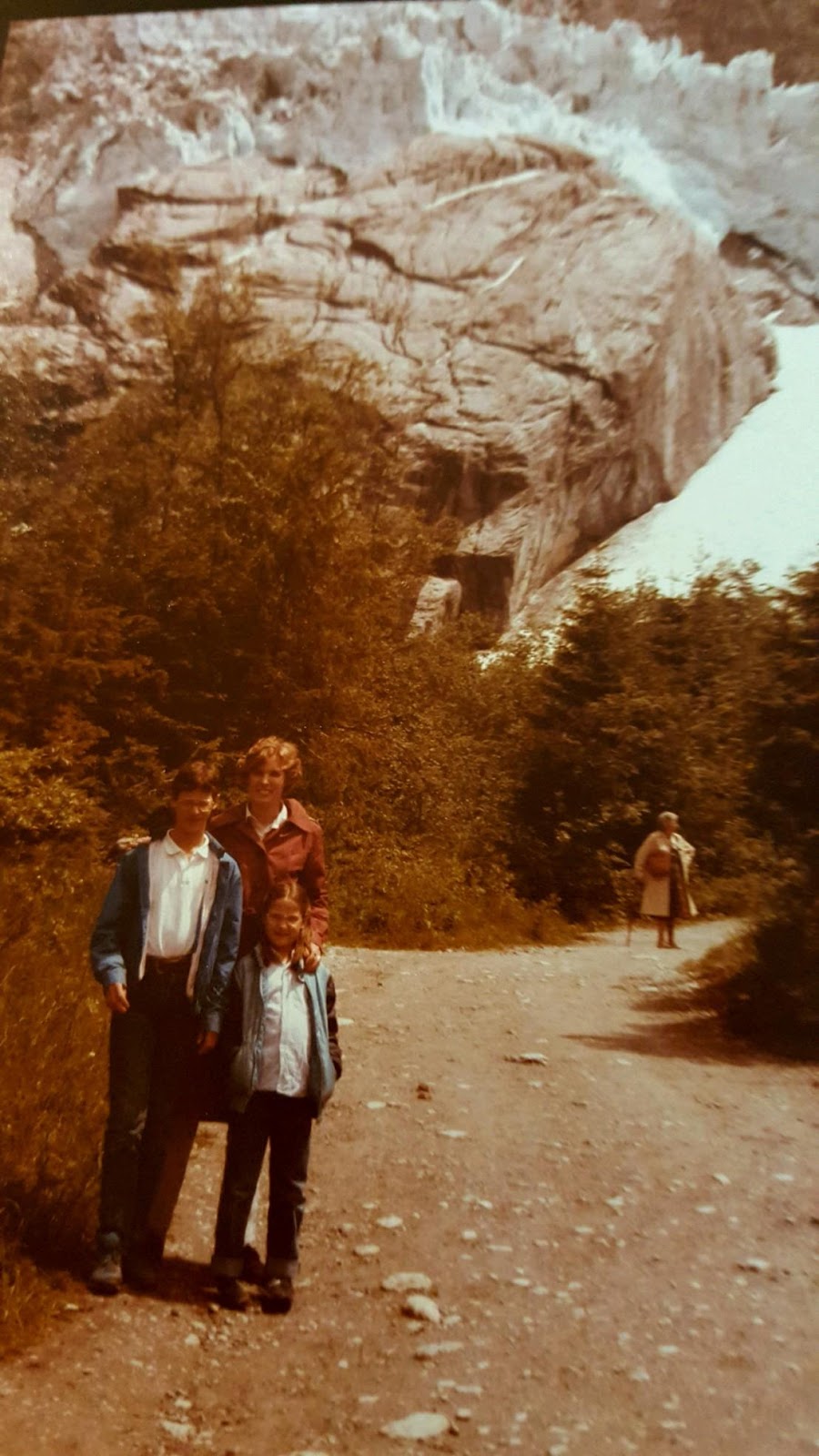
My mom, brother and me in Switzerland, ca. 1985


Folklore:

Swiss-Alpine Folk-Tales, re-told by Fritz Müller-Guggenbühl, translated by Katharine Potts, Oxford UP, 1958.
I actually renewed my library card in order to get this one. I had a $.30 fine from 2009, which is why my name was still even in the computer system. “The city never forgets,” the librarian said. Indeed.
The tales  in this volume are particularly pre-occupied with milk products and often revolve around the making of and/or wasting of cheese. For example, in one tale called "The Alp that Disappeared," a wealthy man paves the rocky path up the mountain with goat cheese so that his girlfriend’s fancy shoes will not be ruined. This is considered a sign of sinful excess and a waste of good cheese, and the man’s own mother (who is starving at the bottom of the mountain while he is paving roads with cheese) prays that he will be punished. A giant hailstorm comes and buries the mountain in ice, which explains how the Blüemlisalp is now covered in glaciers. In another tale, an old woman named Nidelgret (“Cream-Margaret”) is discovered to be using witchcraft to produce a full pail of fresh cream every day. When she is caught by a local cowman, her cabin floods with cream and turns into a milk-white rock in which they both remain imprisoned to this day.

Food:

I’ve had lots of people ask about my food project and tell me I should have blogged it. I took photos of all our meals, but I regret now that I did not blog about it while I was doing it. So, here are my recipes and recollections:
I did my best to find recipe sources that came from people who actually came from the country in question. I would read several recipes and choose the one I liked the best, or combine several of them into something that looked both appealing and authentic. I would also try to find recipes that my phone’s recipe app could recognize, then I would make any edits I felt were necessary and still have the recipe available in my phone when I was trying to cook. So, the recipes that I post will not always be EXACTLY what I made, but they are decent approximations.
Zürcher Geschnetzeltes (Pan-Fried Veal with Mushroom Sauce)
This recipe calls for veal kidneys, which I just omitted from the recipe. We are not big on organ meat in the US, and I wasn’t even sure where to buy that. I also substituted pork loin for the veal, which was much less expensive (the recipe recommends pork loin as a substitution).
Rösti (Potato Fritters)
For the rösti, I used butter instead of goose fat – we are also not big on eating goose in the US, much less frying things in their fat.
Verdict: Delicious! This was a great dish to start my world cooking project. It was not something I would normally cook at home, but it was not totally foreign either. I would definitely make the geschnetzeltes again, but I would make a simpler side. Just some boiled fingerling potatoes with butter and parsley would be great, and a lot less work!

Cocktail:

The legend goes that St. Bernard rescue dogs in the Swiss Alps would carry tiny barrels of brandy around their necks for the poor, frozen wanderers they were rescuing to fortify themselves with. 
Apparently, some “real historians” have called B.S. on that story, but they are absolutely no fun. I’m defying those naysayers by suggesting a brandy cocktail to represent Switzerland in honor of these brave pups. 

The classic cocktail uses 2 oz of Brandy, ½ oz orange Curacao, and 2 dashes each of Angostura and Peychaud’s bitters. For a really Swiss take on the cocktail, you could replace the bitters with a few dashes of Alpenbitter, an herbal digestif from Switzerland. My local store did not carry Alpenbitter, so I used French brandy, the Italian orange-based liqueur Aperol (like Campari, but sweeter), and a dash or two of a German herbal liqueur called Aromatique (similar to Fernet Branca) to encompass Switzerland's three languages. 


Pröschtli!


My Vicarity Project


I’m on the cusp of finishing a global cooking project where I cook one dish from every country in the world, plus a few others (Greenland, for example, which is technically part of Denmark, but which has its own cultural cuisine). I’ve had so much fun with the project that I’m sad to see it go, and I’ve been trying to think of ways I can continue travelling vicariously. Perhaps unsurprising to most people who know me, I landed on reading. So, my new project is to read a book from the same list of countries I used last year for my cooking project. I will be posting summaries, reviews/responses, and other tidbits after I finish each book. I’m also going to read a few folk stories from each country, just to familiarize myself with some traditional storytelling and characters that people from that country might know.

How will I choose the books, you ask?

First of all, I am not the first person to do this, or even to document doing it. Ann Morgan, who is based in the UK, did it first and published a book about it. I haven’t read the book, but I have read her blog, and the list of books she provides on that blog has been extremely valuable for finding works from some of the smaller countries and especially countries whose literature has not been widely translated into English. You can read her blog here: https://ayearofreadingtheworld.com/

Criterion 1:

I will not be using the same set of criteria as Ms. Morgan, although mine is similar. As much as possible, I want to read books by people who actually grew up in the country. So, for example, there are many examples of authors whose families fled their native country and they are writing great books about their parents’/grandparents’ homeland, but they were not born there themselves, did not grow up there and do not currently live there. Or, there are plenty of authors who were born in a country, but left when they were very young and grew up somewhere else. One day, I want to read the books they have written! But my goal with this project is to find people whose formative years were spent living in their country of origin. For some of the smaller countries, where only one book has ever been translated into English, this might not be possible. Fine. I’m happy to read what’s available! But, for countries where I get my choice of books, I want to choose authors who grew up in the country in question. In cases of countries with a colonial history, I am attempting to find indigenous authors.

Criterion 2:

As much as possible, I would like the setting of the book to be the country of origin.

Criterion 3:

I want to read novels or short stories, not poetry, autobiographies or memoirs. This will no doubt prove difficult, and I imagine that I will end up reading some poetry or memoirs just because of a lack of availability of other genres. I am fine with that, but my preference is for fictional prose.

Criterion 4:

I am not restricting myself to contemporary authors, and I reserve the right to use this project as an excuse to read things I’ve been meaning to read, but have never gotten around to (I’m looking at you, Don Quixote!). That being said, I’ve already made the preliminary list of books (although it is subject to change), and most of them are contemporary novels.

I am, however, restricting myself to books I have never read before. No re-reading!

Criterion 5:

Whenever possible, I have chosen a different book than Ms. Morgan did. I have been conscientious about cross-checking against her list and finding books and authors to add to it rather than just copying her work. I have the benefit of doing my project six years later, so there are six years’ worth of new books and new translations to choose from. In some cases, however, the pickings are slim or the cost of obtaining a book may be prohibitive, so there will be some overlap. Again, my task was made immensely easier by her extensive groundwork!

The books/countries will not appear in any particular order. I’m going to follow the same order as my cooking project list, which was loosely organized around national holidays.

First up: Switzerland!

Monday, June 27, 2011

Wed, Jun 27 - Ladislaus of Hungary

Today we drove to Alamogordo to take a sunset hike in the White Sands National Monument. We didn't end up actually going on the hike because it got super windy and the sand was blowing everywhere. Not that fun. But we did walk around for a while before it got too windy. It was pretty neat:


This little guy has adapted his color to match the white sand. He was scared of us, but he finally sat still long enough for me to snap a shot of him.


Today is the feast of St. Ladislaus of Hungary. He was king of Hungary in the 11th century. He conquered a lot of then-heathen lands such as Croatia and parts of Romania and converted them to Christianity. There are many Hungarian folksongs about him which praise his chivalry. Here is the image of him on which my outfit is based:

I actually brought a different outfit than I'm wearing in the pictures. I have my red skirt, and I brought a brown woven belt to wear. When I put it on, though, it looked weird. The shapes didn't go together, and my tank top was too long for the belt and I ended up looking like some kind of weird farmer's daughter or something. So, I went with jeans again. Ah, well. At least the tank top matches.

Sunday, June 26, 2011

St Anthelm

Today is Carlsbad Caverns Day!

It is also St. Anthelm's Day. I don't have a whole lot of biographical information about him, but he was the abbot of the monastery of the Grand Chartreuse which is a very famous Carthusian monastery in France. It still exists and is still a religious house, so no visitors are allowed. Matthew Arnold, the English poet, wrote a poem titled "Stanzas from the Grande Chartreuse" when he stayed there as a guest - I guess that was before the No Visiting policy was put in place.


My outfit is based on the liquor Chartreuse which was once produced at the abbey, but which is now produced in a factory nearby.


Proceeds from the sale of the liquor still benefit the monastery, however. Chartreuse comes in two colors - green and yellow. I am going with green today:

Saturday, June 25, 2011

St. Fridolinus

Today is our first day of vacation!!!!!

I have planned saints of the day outfits for everyday, though. It helps me pack!

Today is just a driving day, so I went for comfort. The saint of the day is Fridolinus, and his story involved one of my favorite subjects: zombies! No lie.

He was an Irish monk in the 5th century who travelled around Germany and Switzerland. He converted two brothers named Ursus and Landolph. However, Ursus died and Landolph returned to his wicked ways. Hearing this, Fridolinus re-animated the corpse of Ursus and led him by the hand to go meet his brother. Rather than trying to eat his brother's brains, however, Ursus admonished him for his bad behavior and Landolph repented and returned to following Christ. Fridolinus led Ursus back to his grave, where the corpse rested again peacefully in death.

To remember Fridolinus, I am wearing the colors of the German flag today, plus my memento mori earrings. Please just disregard the wet hair.

ROAD TRIP! Yay!

Thursday, June 23, 2011

St. Aethelthryth

Saint of the Day: St. Aethelthryth is known by several names including both Etheldreda and Audrey, but I know her as Aethelthryth since we had to read her Vita in Old English. She was the daughter of the king of East Anglia and although married twice, remained a virgin for her entire life. She became abbess of Ely, and suffered from a giant tumor on her neck. She claimed that the neck tumor was a punishment for having worn very elaborate and expensive necklaces in her youth. Throughout the Middle Ages, there was a three-day feast in her honor at which people would wear cheap lace neck ribbons to commemorate her.

So, today, I am wearing my blue and red choker with my "Game Over" T-shirt that my mother-in-law gave me. We are going to visit her today, so it seems appropriate. I've worn this outfit before, so I won't post a new picture. Although, it's like 100 degrees, so I'm not wearing those long sleeves today.

Reading:
Old English: The Battle of Maldon. Byrhtnoth has just made the horrible blunder of allowing the Vikings to cross over the water so they can fight. The battle begins tomorrow, I guess. Oh, the suspense!

Middle English: Chaucer's Troilus and Criseyde, Book 1. In which Troilus sees Criseyde for the first time and falls immediately in love. He goes back to his room and faints and sighs for a while until his friend Pandarus - who just happens to be Criseyde's uncle - finds him and offers to talk to her for him.

Contemporary American: Nothing. Still no book. It's kind of been nice having less of a work load, but it's kind of stressing me out, too, since I'm off schedule.

Workout: Maybe when we get back from see the in-laws.

Food:
Breakfast: cheese toast, grapes, coffee
Lunch: pot roast
Dinner: leftover pizza, I think
Snack: yogurt

Wednesday, June 22, 2011

Paulinus of Nola

Saint of the Day: I don't have an outfit to show, but I do have a youtube video to post that demonstrates the crazy party that is associated with the feast of Paulinus of Nola. Paulinus was the bishop of Nola. He was married to a woman named Theresa whom he credits with his own conversion. They joined a monastery together and had one baby daughter who died just 8 days after her baptism. They were both very wealthy people who gave up their worldly possessions to lead religious lives. It was Paulinus who wrote to St. Augustine of Hippo's friend asking of their conversion. It is widely thought that St. Augustine's Confessions are the answer to Paulinus's inquiry.

On Paulinus of Nola's feast day, there is a huge parade in Nola (and other parts of Italy) which involve a several gigantic towers (gigli) which are carried around town. Here is a short video showing one of the towers and the humongous crowd:

http://www.youtube.com/watch?v=PnaVBIDdAvk&feature=related

Reading:
Old English: Today I start The Battle of Maldon which will take several days to get through. So far, the British ruler Bryhtnoth and a Viking ruler are shouting insults at each other. The battle will undoubtedly commence soon.

Middle English: CT - The Parson's Tale and Chaucer's Retraction
The Parson's Tale is really a sermon about the nature of contrition, definitions of and remedies for the seven deadly sins, and types of penance. It was OK. It's in prose, so it was a little harder to get through. There was one passage, though, which was really amusing to me. The Middle Ages were a rough time on fashion. The church really thought it was a total waste of time and even downright sinful to think much about or spend money on clothes. Here's a small excerpt from the Parson's Tale on men's fashion:

"On the other hand, to speak of the horrible inordinate scantiness of clothing, let us notice these short-cut smocks or jackets, which, because of their shortness, do not cover the shameful members of man, and even wickedly call attention to them. Alas! Some of them show the very bulge of their penis and the horrible pushed out testicles that look like the malady of a hernia under their hose; and the buttocks of such persons look like the hind parts of a she-monkey in the full of the moon...As to the hind parts of their buttocks, the thing is horrible to see. For, indeed, that part of their body from which they purge their stinking excrement, that foul part they proudly show to the people in despite of decency!"

If he could only see us now! He would disapprove, I'm sure.

Contemporary American: Still no Caramelo. If it comes before vacation, I'll read it then.

Malory: I got an old reading list from one of my colleagues who took a Malory exam, so I'm going to just copy hers until I get an official reading list from my professor. I'm sure there will be some overlap. I will start reading for this exam after vacation!

Workout: No. I got a massage this afternoon instead.

Food:
Breakfast: toast, juice, coffee
Lunch: grilled shrimp tacos at Fuzzy's
Dinner: Beef stew. It's so hot! Why am I making this? Because I have some beef I need to use up before we leave and all the rest of the ingredients, too. It's simmering now and smells delicious!